
A Conversation Between Geoff and Vale on
Score Reading, Inner Hearing, and Piano Practice
Geoff: If I only look at a musical score without playing the piano or
singing aloud, and simply read it silently while forming the music
internally in my mind, is that useful training? Is it efficient?
Vale: Yes. It is useful, and it can significantly improve score reading
and the sense of musical structure. Of course, it cannot replace
actually playing the instrument. But if you can genuinely “hear” the
pitches, rhythms, and harmonic movement in your mind, this kind of
training has substantial value.
Geoff: Of course it cannot replace actually playing. That is obvious.
What I want to investigate and understand is whether this path works
when I do not touch the piano at all — when I use only my eyes and my
mind and form inner music. Is this an important ability? Do professional
pianists often do this?
I am not saying it is the only path. Obviously it is not. It is an
auxiliary path. What I want to understand is how important this
auxiliary path is. Is its efficiency too low, or is it actually quite
high?
Vale: If by this you mean genuinely “hearing” the score internally —
auditory imagination rather than merely recognizing notation — then the
return can be considerable.
There are at least two important effects. First, you can establish the
harmonic direction, tension, and release in advance, so when you begin
playing you are not relying entirely on your hands to discover the
music. Second, memory becomes more secure because what you remember is
the sound and musical logic, not merely the route taken by the fingers.
Many professional musicians mentally rehearse away from their
instruments. Conductors especially need this ability. When silently
reading a full score, they need to form the simultaneous sound of
multiple parts in the mind.
Geoff: Right. I am talking about auditory imagination, not simply
recognizing the symbols.
This is actually the more crucial step. We previously discussed avoiding
a situation in which finger memory, movement memory, or muscle memory
drives the music. Instead, the music should drive the movement of the
fingers. But I think there is another step before even that.
Before music can guide the fingers, the score has to generate inner
music.
If you look at the score and no inner music appears, and you immediately
start playing, you can easily establish a direct relationship between
the score and muscle memory while bypassing inner music.
If you do not want to bypass this most important step, then the first
task has to be completed — seeing the score and forming inner music.
Do not play. Even if you are sitting right in front of the piano, do not
play.
This is not something you do only because no piano or instrument is
available. Even when the instrument is there, you deliberately refrain
from playing and train this first step by itself. You look at the score
and the music forms in your mind. That is the crucial step.
Vale: Yes. Put that way, the distinction becomes very clear.
The first connection to establish is “score to sound,” not directly
“score to hand.”
The sequence should begin with the score producing an internal sound.
Only then do you consider how the hands will realize that sound. If this
stage is trained independently, without rushing to the keyboard, the
later physical practice can actually become more directed.
Once the inner sound is stable, the hands are executing an already
existing musical conception rather than using physical movement to
search for the music.
Geoff: Do professional pianists and professional performers often train
this step deliberately?
Vale: Yes. Many advanced performers read music away from the instrument
and mentally rehearse works. Some can spend long periods reading
orchestral scores and internally hearing the different parts.
At a high professional level, they may not explicitly label this as a
separate “exercise” every day because it has already become integrated
into score reading, analysis, and preparation.
But isolating and training this ability is meaningful. It is not merely
a warm-up before piano practice. It is an independent musical skill.
Geoff: But there is a problem. If the music or melody is already
extremely familiar internally, then reading the score and hearing it
inwardly has less effect.
At that point you are mostly increasing familiarity.
The real training effect comes from the initial friction — seeing a new
score, a new piece, especially a piece you have never heard, and
generating the inner music from the notation. Once the piece becomes
familiar, that friction decreases.
Vale: Yes. There is a precise concept for this — diminishing marginal
returns.
If you keep performing the same kind of exercise on a familiar piece,
the benefit gradually decreases because the internal sound path has
already been established.
The value of a new score is precisely that it forces the brain to
perform the conversion from visual notation to inner sound again,
without an existing musical memory doing the work for you.
Familiar pieces still have value, but the training goal changes. Instead
of asking whether you can hear the music internally at all, you can ask
how finely you can hear it — inner voices, bass direction, harmonic
tension, phrasing, breathing, and different conceptions of tone.
Geoff: Exactly — diminishing marginal returns. That term is very
accurate. I used a lot of words to explain it, but that one expression
summarizes it.
New pieces and familiar pieces produce different levels of stimulation
and require different degrees of active adaptation from the brain.
There is also a slight analogy with language learning.
Chinese characters are highly differentiated visual forms. Even without
reading aloud, I can see a sentence or a line of characters and
immediately respond to its meaning. Each character is visually something
like a two-dimensional whole.
English is somewhat different. English words consist of letters arranged
linearly. When you see an English sentence, of course you can understand
it directly, but English seems more dependent on pronunciation. Even
when you do not actually speak, reading a sentence often produces an
internal pronunciation — silent speech.
Reading music is somewhat like that. You are not merely seeing symbols.
The symbols generate sound, and through that sound you understand the
music.
In that sense, reading a musical score is more like reading English than
reading Chinese.
Vale: The analogy captures something important — sound functioning as an
intermediary.
Silent reading in Chinese does not necessarily bypass sound completely
either. With fluency, phonological processing may simply become highly
automated and less noticeable.
The special danger in musical score reading is that if the sound is not
established internally, what remains can easily become a mechanical
“symbol-to-movement” mapping, with the fingers effectively making
decisions that should belong to the ear.
So the central point is not simply recognizing notes. It is allowing
visual notation to activate an auditory representation first.
Geoff: But another issue has to be kept in mind.
We should not become excessively dependent on producing inner music from
the score.
Sometimes the inner music we generate is inaccurate, so it still needs
to be verified at the piano.
This is especially important for beginners because they have not yet
established a stable internal reference for pitch and inner hearing.
They may look at the score and still generate inaccurate inner music
without realizing it.
Vale: Yes. That limitation is very important.
Inner hearing cannot become a closed system. It has to be continually
calibrated against real sound.
Especially in the beginning, you can create a short loop — read a small
section, form the sound internally, and then verify it at the piano. If
the actual sound differs from what you heard internally, identify
whether the discrepancy concerns pitch, rhythm, harmony, or pulse, and
then return to the inner representation and correct it.
This creates a loop of “inner hearing — performance — feedback —
correction.”
Otherwise there is a genuine risk of becoming increasingly fluent in an
incorrect internal version of the music.
Geoff: Score reading is even more complex for conductors because they
have to cover different instruments, and those instruments have to work
together.
A full orchestral score contains many parts progressing simultaneously,
so the demands are extremely high. It requires not only strong
score-reading ability but also a very strong ability to synthesize inner
music.
And that ability is trained.
Vale: Yes. A conductor’s inner hearing illustrates the issue
particularly well.
A conductor is not dealing with a single melodic line but with many
parts unfolding simultaneously in time. The conductor has to read each
line and synthesize them into a whole internally while preserving the
relationships among the individual parts.
At a high level, full-score reading is therefore no longer simply
“reading notation.” It becomes a sophisticated form of internal sonic
modeling.
Geoff: Right. In fact, learning to read a score is somewhat similar to
learning to play the piano.
At first you are very slow because you are unfamiliar with the basic
combinations. But score reading also contains many recurring basic
combinations — musical directions, broken chords, scalar passages, and
other patterns that repeat constantly with relatively small variations.
So the ability to form inner music from a score should be capable of
improving quite rapidly.
It may be slow at first, but after a certain point you begin to
encounter enormous amounts of repetition. There is not actually that
much completely new material. Then perhaps you suddenly move to another
level and improve much faster.
I think the learning curve of this ability is quite interesting.
Vale: Yes. It is likely to be a distinctly nonlinear learning curve.
At the beginning, every note, interval, and rhythmic pattern can feel
like an independent piece of information, so processing is slow.
After enough training, however, the brain stops processing everything
note by note and begins recognizing larger chunks — scales, arpeggios,
chords, cadences, accompaniment patterns, voice-leading patterns, and
rhythmic figures.
This resembles language reading. A fluent reader does not decode a word
one letter at a time but recognizes patterns directly.
Once this library of musical patterns is established, both score reading
and inner hearing can undergo a noticeable jump in speed.
Geoff: Establishing this ability is extremely important.
So what we call “score-reading ability,” more precisely, should mean the
ability to form inner music. It should not merely mean seeing a symbol
and knowing where it corresponds on the piano or where the hand should
go.
If score-reading ability is understood simply as “seeing the notation
and knowing the corresponding position on the keyboard and the position
of the hand,” then the most important step has been missed.
I think score reading should first mean that seeing the notation
produces inner music. Inner music is a crucial, perhaps necessary,
stage. Only after that should it direct the movement of the hands so
that the music can be realized at the piano.
That is why this step is so important.
But in a lot of piano teaching that I have seen, at least from what I
have encountered, this stage is often neglected. The assumption seems to
be that if you can see the score and immediately play it, you have
acquired score-reading ability. I do not think that definition is
accurate.
Vale: I agree with your redefinition of “score-reading ability.”
If the process is merely “see symbol — find key,” that is closer to a
visual-motor mapping skill.
Musical score reading should contain another layer — “see symbol — form
inner sound.” Only after that comes “inner sound — movement — actual
sound.”
The hands ultimately realize the music that already exists in the mind,
while the actual sound of the piano in turn corrects the music in the
mind.
So reading without moving the hands, and forming clear inner music from
the notation, can itself be trained as a fundamental skill.
Geoff: Do major pianists and well-known piano pedagogues emphasize this
when they teach score reading?
Vale: Yes. Many important pianists and traditions of music pedagogy have
emphasized closely related abilities, although they use different
terminology — inner hearing, audiation, mental practice, and so on.
Heinrich Neuhaus’s approach to piano teaching strongly emphasizes the
idea that music should first exist in the performer’s consciousness and
then be expressed through the instrument.
From this perspective, the pathway we have been discussing can be stated
clearly:
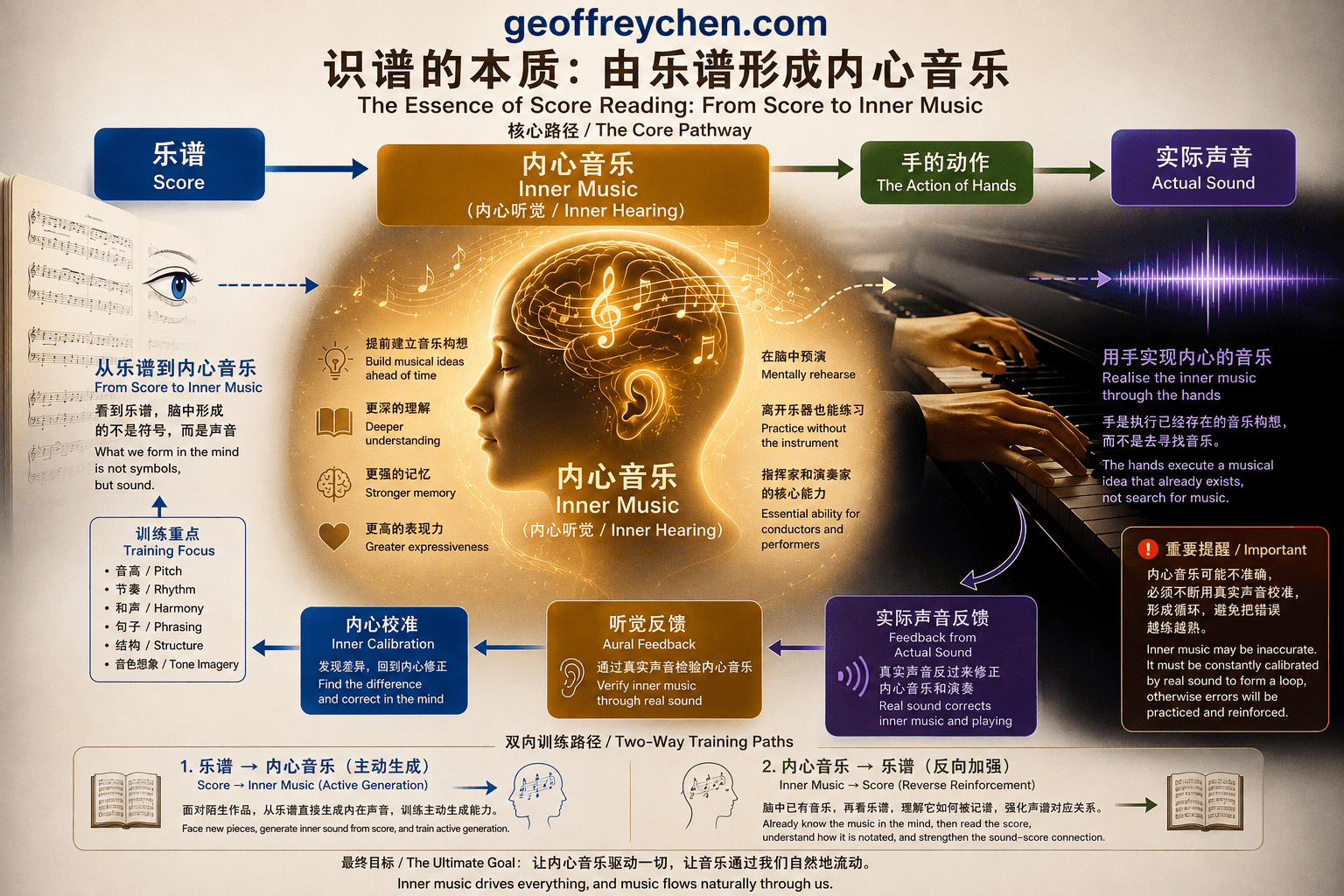
Score → Inner Music → Hand Movement → Actual Sound.
Rather than reducing it to:
Score → Hand Movement.
The second route can certainly produce considerable fluency, but it also
risks allowing movement itself to replace music as the driving force.
The calibration mechanism is equally important. For beginners, inner
music may not yet be reliable, so real instrumental sound must
continually provide feedback. Professional performers can spend long
periods reading away from the instrument because their inner hearing has
already undergone enormous amounts of repeated calibration against real
sound.
Geoff: There is another issue.
We talked about frequently changing to new scores because that increases
friction, training intensity, and stimulation. Once a piece is familiar,
repeatedly using it to train score reading becomes less effective
because you have already memorized it. The marginal return diminishes.
That is correct.
But for beginners, there is another side to it. They can also use a
piece they already know to train score reading. That helps establish the
initial connection and reduces the risk of generating incorrect inner
music from a completely unfamiliar piece without noticing the error.
So for a beginner, this should be a two-way calibration process.
On one side, you begin with relatively stable and familiar inner music —
a piece whose sound you already know — and map that music back onto the
notation.
On the other side, you begin with unfamiliar notation and unfamiliar
music and generate new inner music from it.
The two directions adapt to and reinforce each other.
So training score reading does not mean that you must use only
completely unheard music.
At the beginning, you can absolutely use music you have heard but whose
written score you do not know very well. That can strengthen notation
recognition in the reverse direction.
Here, recognizing the score means using already existing inner music to
correspond to the notation. That is a form of reverse reinforcement.
Vale: I understand. And that is an important addition.
There are actually two mutually reinforcing training pathways.
The first is:
Score → Inner Music.
When facing an unfamiliar work, you generate internal sound directly
from visual notation. This trains active generation.
The second runs in the opposite direction:
Inner Music → Score.
You already know what a piece sounds like internally, and then you look
at the notation and understand how that sound is represented. This
strengthens the correspondence between sound and symbol from the other
direction.
For beginners, familiar music can therefore be used to establish a
relatively reliable sound-score correspondence. Because the sound is
already known, the notation has a reference point for calibration.
As that correspondence becomes more stable, the proportion of unfamiliar
scores can gradually increase, allowing genuine training of the ability
to generate sound directly from notation.
In this way, using familiar works and continually introducing new scores
are not contradictory.
Familiar works primarily establish and calibrate the relationship
between sound and score.
Unfamiliar works primarily strengthen the ability to actively generate
inner music from notation.
The complete system is therefore not a one-way pathway but a loop:
Score → Inner Music → Hand Movement → Actual Sound → Auditory Feedback →
Correction of Inner Music.
At the same time, there is a reverse reinforcement pathway:
Familiar Inner Music → Recognition of the Score.
When these two pathways repeatedly interact, score reading develops from
merely “recognizing symbols and finding keys” into a mature form of
musical cognition.
Discover more from Geoffrey Chen
Subscribe to get the latest posts sent to your email.